03 December 2006

Oasis in the Woods


Copyright 2006 Globe Newspaper Company
All Rights Reserved
The Boston Globe

December 3, 2006 Sunday
THIRD EDITION
SECTION: MAGAZINE; Pg. 48
LENGTH: 440 words
HEADLINE: Oasis in the WoodsTheir little retirement house didn’t have a dining room – or any ponds – so they created both.
BYLINE: By Rachel Levitt - Rachel Levitt is a freelance writer. E-mail comments to rachellevitt@comcast.net.

BODY:
HOME OF THE YEAR / THE BEST ADDITION

Betsy Kendall describes her Harvard home as "the dream we didn't know we had." She and her husband, Steve, a retired advertising executive, thought they had already bought and sold their dream house, a modern gallerylike edifice with 30-foot ceilings. In 2004, they "bought down," as Steve says, to lower their expenses and live well in retirement. But the little Harvard house needed a few modifications. Steve had studied cooking in France, and Betsy, a retired financial-training consultant, is an avid amateur chef. "We knew we needed a dining room and to expand the kitchen," Betsy says. "We entertain a lot." They also knew that they wanted a pond on their nearly 3-acre wooded lot.

They hired architectural designer Deborah Bentley of Bentley Design Associates in Carlisle to help them execute their plan. "She really ran with it," says Steve. "We said, 'Give us a dining room,' and she gave us much more." Bentley imagined integrating the water feature into the design of the house, digging up the front yard to create the pond and adding a bridge. The Kendalls loved the idea, and Steve made a 3-D foam-core model of the project, even depicting the stones in the pond. "We read landscaping books to get general ideas about symmetry, plantings, and technical advice," Betsy says.

The entrance to the house includes a 21-foot-long gangplank that passes over the pond and connects the driveway to the front door. A 7-foot-high waterfall under the dining room connects the formal upper pond to the more "organic" lower pond. The sound of rushing water is ever-present. "It's loud, but it's pleasantly loud," says Steve. "We call it a dull roar." The Kendalls selected Japanese-inspired plants and stocked the ponds with 10 koi. As soon as construction was finished, dozens of frogs took up residence in the man-made habitat, and "Mr. Snake," the resident garter snake, began lounging on the rocks. "We created our own ecosystem," Betsy says. Winter and the local heron will determine which koi get names – the Kendalls have thus far resisted getting too attached.

To complete the scene, they commissioned Somerville artist David Tonnesen to create an outdoor sculpture. "We wanted something that would reflect nature," says Steve. "That was a challenge, because David works in stainless steel." Set by an archway that leads to the lower pond and the woods behind the house, Tonnesen's glistening 13-foot kinetic installation both counters and complements the natural setting in a silvery cluster that resembles reeds, leaves, and petals. Says Steve: "It is very much like what we see in the lower pond."

LOAD-DATE: December 6, 2006

13 October 2006

Artist Profile: Samuel Bak


www.wellesleywestonmagazine.com
TITLE: Artist Profile: Samuel Bak
MAGAZINE: copyright Wellesley Weston magazine
DATE: Fall 2006
WORDS: 800
BYLINE: Rachel Levitt

I met Samuel Bak in a heavy rain in early May. His first words to me as I dripped over his tile entrance were, “You don’t have luck with the weather.” From this petite man with large glasses and neat grey beard, it sounded more like prophecy than observation.

Samuel Bak is a world-renowned painter; that he lives in Weston is a fluke. Several years ago he and his wife, who were living in Switzerland, decided to look at houses in the Boston area. He never imagined himself suburban. “No pool!” he declared, “I want to walk everywhere so we must live in the city!” but it was here that they found their perfect home.

We walked together from the foyer into Bak’s studio, home, and temple. From within, the house revealed its precious bones: a previous owner had freed the one hundred year old timber frame of walls and ceilings, creating a soaring atrium that opened to an outdoor pool. At the foot of the pool was a single magnificent pine tree.

Any story about Bak is also a story about the best and worst of the past century. He is a holocaust survivor from the city of Vilna, Lithuania, which in 1938 was home to 106,000 Jews. By the war’s end, 100,000 had perished. Bak emigrated to Munich, then Israel, Paris, Rome, New York City, and finally, Switzerland. As a result, he is an articulate man, fluent in multiple languages, and a citizen of three countries. He has a cutting intellect and is a connoisseur of fine things, a man of the world.

He spoke slowly so that I could not misunderstand him, emphasizing occasionally for clarity, not drama. “All of my paintings are memorials,” he explained, “but the real memorials are stories. War and Peace, for example, was a memorial to the Napoleonic wars in Russia, and it lives over and over in our imagination. Physical monuments are problematic because they tend to speak to a specific generation. When I was in Paris in the 50s, I saw many monuments to the First World War. Some were beautiful. All were emotional, noble, and costly sculptures, often of a dying soldier in the bosom of an angel. These were symbols of glory but they all looked funny to me. The most poignant memorial was the Monument Against Fascism, [by Gerz, placed in Harburg, Germany in 1986]—an obelisk in lead, 36 feet high that slowly sank into the ground, eventually disappearing. The only thing that remains of this monument is its memory.”

We stood up and he led me across the flat woven Afghani rugs, past a skull, a bowl, a disarming life-sized statue of a 1920s dandy, the books, the African masks, the unusual, the sculptural, the visual. Opera played from somewhere deeper. Then we turned to the walls. There were the paintings, framed and hung with magnificent care. When you enter his work’s aura and stand within arm’s reach, you can examine it and search the surface with your eyes. It is perfect. Bak paints with an angel’s wing, leaving no trace of origin on the canvas, creating mystical worlds with unparalleled depth in a hair’s breadth.

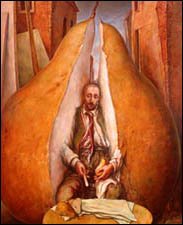
Outwardly, all of his work is a visual testament to the horror of the holocaust. He approaches the subject directly, working themes over and over—the boy, burning, loss, Jewish symbols, with tremendous discipline. It is hard to discern animate from inanimate, figure from landscape. A succulent pear, upon further investigation, is made of marble. Its form wavers between positive and negative; it is an elaborate optical illusion. How much exists and how much is merely implied? The figures are broken, disconnected, and frozen—though they are fixed, there is blood pulsing just beneath the skin. These themes suggest an explorer of modern displacement; as such, Bak joins the ranks of the great existential artists such as Otto Dix and Francis Bacon.

While the images haunt, the timelessness and perfection of Bak’s technique virtually stun. Like his careful speech, he wants his images to be clearly understood. To this artist, their value as memorials requires that the symbols are apparent but their significance endlessly debatable. Like a parable, the torah, or the bible, Bak’s paintings live as long as people mine them for meaning. Here a man sits in a pear. The pear is knowledge. Is the man emerging from the pear or being consumed by it?

There are Dali-esque still lifes, part memory, part dream. And one is reminded of another surrealist: Heironymous Bosch, the fifteenth century artist of meticulous nightmares, who imagined earthly delights—sex, torture, and gluttony, as the downfall of mankind. Bosch is here, and through Bak, he is made modern.

The holocaust is almost three generations in the past, but Bak has spent his time working to keep the record open. He believes that teaching through his images is his life’s work, which is perhaps why the paintings come one after the next, purposefully. Unlike many artists, the images come to him as soon as he sets his brush to a new canvas. As proof, he is prolific.

I spoke to him four days before he set off for Europe—to Germany for a show of his work, to Switzerland to see his mother in law, to Paris to be with his daughter. He admitted that he hated to travel, and couldn’t wait to return. I was clearly puzzled, so he explained, “I don’t enjoy trips because all the best trips are in my head.”

He still finds it remarkable that the Germans were the first to come to terms with what the Nazis had wrought, and admires their tenacity in confronting the truth. “One young man met me in Berlin when I had a show there, and I would not have been treated better had he been my own son. He picked me up, drove me places, took me to dinner.” Another woman is eager to meet Bak when he returns to Germany this time. Her father was a prison guard where Bak and thousands others were deliberately starved. The man is still alive and has never spoken of this, so his daughter reaches out to the survivor.

17 September 2006

Sweet and Simple

Copyright 2006 Globe Newspaper Company
The Boston Globe
September 17, 2006 Sunday
THIRD EDITION
SECTION: MAGAZINE; Pg. 14
LENGTH: 506 words
HEADLINE: SWEET AND SIMPLE;
ARCHITECT ELIZABETH WHITTAKER TURNS PARTICLEBOARD INTO A CLEVERLY DELICOUS DESIGN STATEMENT.
BYLINE: BY RACHEL LEVITT

BODY:

That it always seems sunny at Vicki Lee's in Belmont is a tribute to architect Elizabeth Whittaker's vision for the bright, minimalist space. A yellow awning along Trapelo Road sets the stage for what is at once simple (mostly exposed particleboard) and complex (no exposed fasteners anywhere - a frightening prospect for even the savviest of builders).

Vicki Lee Boyajian, who has been in the food business almost all her life (with the exception of a brief foray into real estate), found the inspiration for the look of her new cafe in an unlikely place: the Middlesex Lounge in Central Square, Cambridge, an award-winning hipster club designed by Whittaker. Boyajian instinctively recognized that Whittaker's clean aesthetic would provide the right stage for her triple espresso tortes, coconut-lime tea cakes, and purple, yellow, yellow, red, and gold Anzac cookies (said to have been baked by or for the Australian and New Zealand Army Corps field soldiers during the World War I battle of Gallipoli).

True to form, Whittaker demonstrates her mastery of the discipline; her design appears fresh and effortless. But look closer: The flooring, for example, bleached particleboard glued to the subflooor. It was an untried technique and the floor's installation involved significant shimming, four coats of sealer, and a few coats of urethane before designer and client were satisfied it would resist the daily grind. Such willingness to take on risks for a better product mirrors Boyajian's tireless quest for pastry perfection.

You can taste it best in the Danish croissant, made with hand-rolled dough. Most bakers use machines to knead their dough, Boyajian explains, but that overdevelops the gluten and sacrifices lightness for speed. Rather, she adheres to the creed an Italian chef at Le Bocage taught her when she first entered the business: Use all your senses, your eyes, nose, and fingers, to lead you.

Likewise, Whittaker's design features a rich palette that is tactile and harmonious: the cool frameless glass, the crazy quilt-like plywood, and the white lacquered counters invite touch. Further teasing the senses, a translucent wall separates kitchen from cafe. Boyajian casts shadows against this wall, silhouettes of her long, sinewy baker's arms remind those of us sipping a perfect cappuccino how privileged we are to sit in this sunny place and enjoy two labors of love.

NOTES: BOSTON UNCOMMON ; DESIGNING Rachel Levitt is a freelance writer in Cambridge. E-mail her at r.levitt@neu.edu.

GRAPHIC: PHOTO

LOAD-DATE: September 27, 2006